

This Subaru Ascent is equipped with an advanced SUBARU frontal airbag system engineered to meet the latest safety regulations, including the updated Federal Motor Vehicle Safety Standard (FMVSS) No. 208. This modern safety technology is designed to enhance occupant protection by intelligently adapting to real-world crash conditions.
The Subaru Ascent advanced frontal airbag system continuously analyzes collision severity and passenger conditions. Based on this data, it automatically determines the optimal deployment force for the driver’s SRS frontal airbag and decides whether the front passenger’s airbag should deploy at all, as well as how forcefully it should activate.
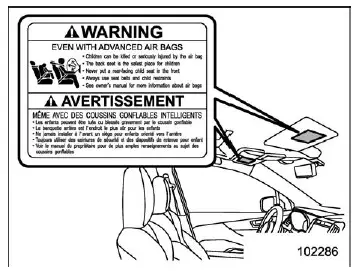
This Subaru Ascent includes clearly visible warning labels on both sun visors and an additional safety tag inside the glove compartment, all emphasizing critical safety instructions beginning with “EVEN WITH ADVANCED AIR BAGS.� Carefully reading and understanding these warnings is essential for safe vehicle operation.
Seatbelts must always be worn. The Subaru Ascent advanced frontal airbag system functions as a supplemental restraint system and is not a replacement for seatbelts. All occupants must be properly secured using seatbelts or appropriate child restraint systems to ensure maximum protection.
In moderate to severe frontal collisions, the Subaru Ascent may deploy multiple safety components simultaneously:
- SRS frontal airbag for the driver
- Front passenger SRS frontal airbag
- Driver’s SRS knee airbag
- SRS curtain airbags*1
*1: Curtain airbags may deploy in severe offset frontal collisions where additional head protection is required.
These integrated safety components work together to reduce impact forces on the head, chest, and lower body, significantly minimizing the risk of serious injury.
NOTE
Only the driver’s and front passenger’s frontal airbags are actively controlled by the Subaru Ascent advanced frontal airbag system logic.
Driver's SRS frontal airbag
The driver’s airbag in the Subaru Ascent utilizes a dual-stage inflator that adjusts deployment intensity depending on crash severity, ensuring a balanced response between protection and injury prevention.
Front passenger's SRS frontal airbag
The front passenger airbag system in the Subaru Ascent combines a dual-stage inflator with an actuator, allowing even more precise control of deployment behavior based on occupant presence and impact conditions.
Both the inflator and actuator operate dynamically, adapting in real time to provide optimal safety performance.
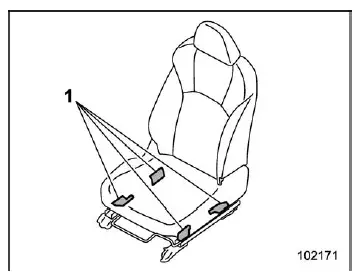
- Occupant detection sensors
The Subaru Ascent is equipped with advanced occupant detection sensors located beneath the front passenger seat. These sensors evaluate passenger size, weight distribution, and seating posture to determine whether deployment of the front passenger airbag is necessary.
In certain situations, the system may intentionally prevent deployment of the front passenger airbag even if the driver’s airbag is activated. This is normal system behavior designed to reduce unnecessary risk. In such cases, the seatbelt pretensioners for both driver and passenger will still activate to provide protection.
CAUTION
Follow these important precautions carefully.
Failure to observe these guidelines may compromise the performance of the Subaru Ascent advanced frontal airbag system or lead to system malfunction.
- Avoid applying strong impacts to the front passenger seat, such as kicking or hitting it.
- Do not allow rear passengers to place their feet between the front seatback and seat cushion.
- Prevent liquids from spilling onto the front passenger seat. If a spill occurs, clean and dry the area immediately.
- Do not remove, modify, or disassemble the front passenger seat structure.
- Only install genuine Subaru Ascent accessories under the front passenger seat.
- Do not store objects such as shoes, bags, or umbrellas under the front passenger seat.
- Avoid placing books or other items around or on the front passenger seat.
- Never use the front passenger seat without the head restraint properly installed.
- Do not leave items on the seat or keep the seatbelt latched when exiting the vehicle.
- Do not place sharp objects on the seat or damage the seat upholstery.
- Avoid placing magnets near seatbelt buckles or retractors.
- Ensure that the front seats are securely locked in position before driving.
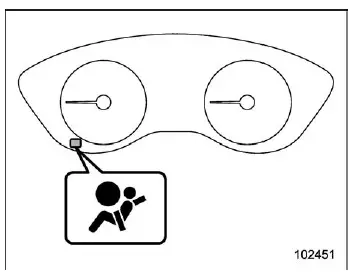
SRS airbag system warning light
If the Subaru Ascent detects a malfunction in the seatbelt buckle switch or occupant detection system, the SRS airbag warning light will illuminate. This indicates a potential safety issue that requires immediate attention.
If the warning light turns on, stop the vehicle safely as soon as possible and contact an authorized Subaru dealer for inspection and repair.
Additionally, if the Subaru Ascent has been involved in any type of collision or impact, even a minor one, the airbag system should be inspected to ensure proper functionality.
Until the system has been checked, avoid using the front passenger seat to reduce potential safety risks while driving to a Subaru service center.
Proper understanding and maintenance of the Subaru Ascent advanced frontal airbag system ensures maximum safety for all occupants and helps the system perform as designed in critical situations.
Related manual topics
Uniform tire quality grading standards
The Uniform Tire Quality Grading (UTQG) system provides valuable comparative
information about tire performance, specifically in the areas of treadwear, traction,
and temperature resistance. For Subaru Ascent owners, understanding these ratings
can help in selecting the most suitable tires for ...
Select lever
Select lever positions
Select lever button
: With the brake pedal depressed, shift while pressing the select lever button in.
...