

Perform a visual inspection of the tires on your Subaru Ascent on a daily basis to ensure they are free from serious damage, embedded nails, stones, or other foreign objects. At the same time, carefully examine the tread surface for any signs of uneven or abnormal wear, which may indicate underlying issues.
If any irregularities or damage are detected, contact your SUBARU dealer immediately to prevent further deterioration and ensure safe operation of your Subaru Ascent.
NOTE
- When the wheels and tires of your Subaru Ascent strike curbs or are
exposed to harsh driving conditions such as rough roads, hidden damage may occur
that is not immediately visible.
This type of internal damage may only become noticeable over time. To minimize risk, avoid driving over curbs, potholes, or uneven surfaces whenever possible.
If unavoidable, reduce speed to walking pace and approach obstacles directly rather than at an angle. Also, avoid pressing the tires against curbs when parking your Subaru Ascent.
- If you notice unusual vibrations while driving or difficulty maintaining
a straight path, it may indicate damage to one or more tires or wheels.
In such cases, drive carefully to the nearest authorized SUBARU dealer and have your Subaru Ascent inspected without delay.
Tire pressures and wear
Maintaining correct tire pressure is essential for maximizing tire lifespan, ensuring proper handling, and achieving optimal fuel efficiency in your Subaru Ascent. Check and adjust the tire pressure, including the spare tire (if equipped), at least once a month and before any long-distance travel.
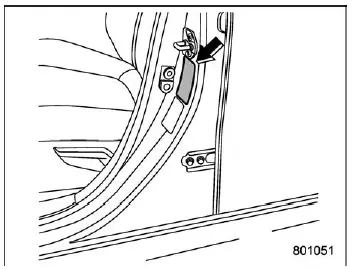
Tire inflation pressure label
Always measure tire pressure when the tires are cold for accurate readings. Use a reliable pressure gauge and adjust the pressure according to the values indicated on the tire inflation label, which is located on the driver-side door pillar of your Subaru Ascent.
Even short driving distances can increase tire temperature and pressure. Additionally, ambient temperature changes significantly affect tire pressure. Therefore, checking tire pressure outdoors before driving is the most accurate method.
As tires heat up, the air inside expands, increasing pressure. Avoid releasing air from warm tires, as this can result in underinflation once the tires cool down.
NOTE
- Tire pressure typically increases by approximately 4.3 psi (30 kPa, 0.3 kgf/cm²) as the tire warms up during operation.
- Tires are considered cold when your Subaru Ascent has been parked for at least three hours or driven less than 1 mile (1.6 km).
WARNING
Never release air from warm tires to adjust pressure. Doing so will result in underinflation, which can negatively affect vehicle stability and safety.
Incorrect tire pressure can reduce driving comfort, impair handling, and lead to uneven or accelerated tire wear on your Subaru Ascent.
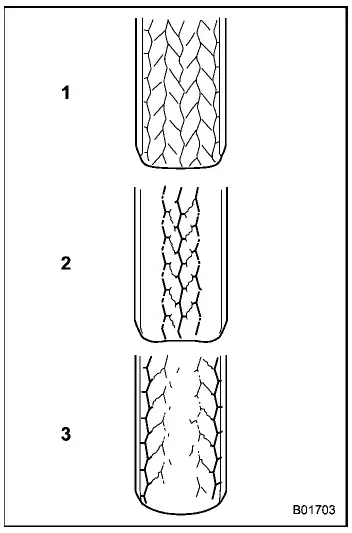
- Correct tire pressure (tread worn evenly)
Road grip is optimal, steering response is precise, and rolling resistance is minimized, contributing to improved fuel efficiency. - Underinflated tire (tread worn on edges)
Increased rolling resistance leads to higher fuel consumption and reduced tire lifespan. - Overinflated tire (tread worn in center)
Ride comfort decreases, and the tire becomes more sensitive to road imperfections, potentially causing damage to your Subaru Ascent.
If the tire pressure label indicates values for a fully loaded vehicle, adjust the tire pressure according to the current load conditions to maintain safe handling and stability.
WARNING
Driving at high speeds with insufficient tire pressure can cause excessive deformation and rapid heat buildup in the tires. This may lead to tread separation or complete tire failure, resulting in loss of control and a potentially serious accident.
Wheel balance
Although the wheels of your Subaru Ascent are precisely balanced at the factory, they may become unbalanced over time due to tire wear and regular use.
Wheel imbalance can cause noticeable steering wheel vibration at certain speeds and may reduce straight-line stability. Additionally, it can contribute to uneven tire wear and place extra stress on suspension and steering components.
If you suspect imbalance, have the wheels of your Subaru Ascent checked and balanced by a SUBARU dealer. It is also recommended to perform balancing after tire repairs or rotation.
CAUTION
Incorrect wheel alignment may cause uneven tire wear and reduce vehicle stability. If abnormal wear patterns are observed, consult your SUBARU dealer immediately for inspection and adjustment.
NOTE
The suspension system of your Subaru Ascent is engineered to maintain precise wheel alignment, ensuring optimal stability, handling, and cornering performance under normal driving conditions.
Regular tire inspection and proper maintenance of your Subaru Ascent not only enhance driving safety but also improve efficiency and extend the lifespan of critical components.
Related manual topics
Selection of manual mode
In the Subaru Ascent, manual mode allows the driver to take direct control over
gear selection for a more engaging and responsive driving experience. Whether the
vehicle is stationary or in motion, you can activate this mode by moving the select
lever from the "D" (Drive) positio ...
Remote engine start system (dealer option)
WARNING
Before using the remote engine start feature on the Subaru Ascent, always
review and understand all safety precautions related to engine starting.
Proper use of the system is essential to prevent accidents and ensure
safe operation.
Never activate the Subaru Ascent rem ...