

If a flat tire occurs while driving your Subaru Ascent, it is essential to remain calm and avoid any abrupt braking. Instead, maintain a straight driving path and gently reduce your speed in a controlled manner, allowing the vehicle to decelerate smoothly without compromising stability.
After slowing down safely, carefully guide your Subaru Ascent off the roadway to a secure and stable location, ideally on a flat and solid surface away from traffic.
Changing a flat tire
WARNING
- Always use the original jack and jack handle supplied with your Subaru
Ascent.
The factory-provided jack is specifically engineered for tire replacement only. Never place any part of your body underneath the vehicle while it is supported by the jack, as this may result in severe injury or even fatal consequences.
- Do not attempt to raise the vehicle on sloped or unstable ground.
If the surface is uneven or loose, the jack may slip or sink, causing the Subaru Ascent to fall unexpectedly and potentially leading to serious injury.
- Before lifting the vehicle, ensure that no passengers or cargo remain inside the Subaru Ascent.
- Never position the jack on top of or under any objects.
Improper placement can destabilize the jack, significantly increasing the risk of an accident.
- Switch off the engine completely before lifting the flat tire off the ground. Do not shake, push, or rock the Subaru Ascent while it is supported by the jack, as even minor movement may dislodge it from its position and cause serious injury.
- All occupants must exit the vehicle before raising it with the jack. Lifting a loaded Subaru Ascent is extremely dangerous and can lead to loss of stability.
- Never start or run the engine while the Subaru Ascent is supported by the jack, as this may cause sudden movement and result in severe injury.
CAUTION
Take care not to strike or deform the brake disc backing plate during wheel removal or installation. Damage to this component may cause it to rub against the disc rotor, resulting in noise and possible performance issues while driving your Subaru Ascent.
NOTE
For operations involving a garage jack, it is recommended to contact an authorized SUBARU dealer to ensure safe lifting procedures.
1. Whenever possible, park your Subaru Ascent on a firm and level surface, then turn off the engine completely.
2. Firmly engage the parking brake and shift the selector lever into the "P" (Park) position to prevent any unintended movement.
3. Activate the hazard warning lights and ensure that all passengers and cargo are removed from the Subaru Ascent before beginning the procedure.
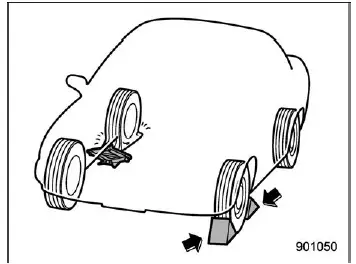
4. Place wheel chocks both in front of and behind the wheel diagonally opposite the flat tire to secure the Subaru Ascent in place.
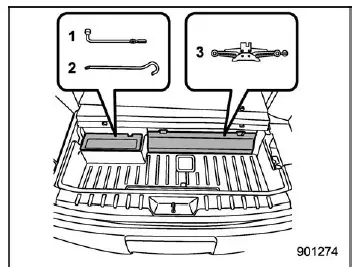
- Wheel nut wrench
- Jack handle
- Jack
5. Retrieve the jack, jack handle, and wheel nut wrench from the storage area located beneath the cargo floor of your Subaru Ascent. Refer to the section "Maintenance tools" for exact placement.
Proper preparation of tools ensures a smoother and safer tire replacement process.
NOTE
Before use, confirm that the jack mechanism is properly lubricated to allow smooth and reliable operation.
6. Remove the spare tire from its designated storage location.
Refer carefully to the section "Removing the spare tire" and strictly follow all provided instructions for your Subaru Ascent.
NOTE
If your Subaru Ascent is equipped with a temporary spare tire, review the section "Temporary spare tire" in detail and follow all usage limitations and safety recommendations.
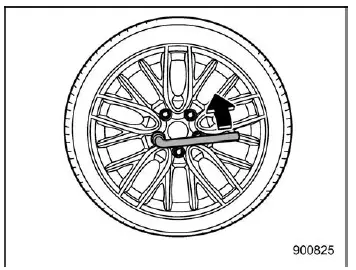
7. Slightly loosen the wheel nuts using the wheel nut wrench, but do not remove them completely at this stage.
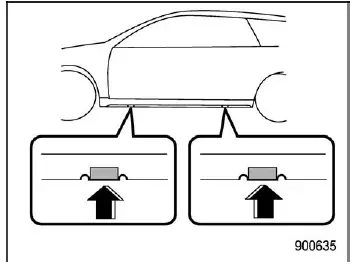
Jack-up points
8. Position the jack beneath the side sill at the designated front or rear jacking point nearest to the flat tire on your Subaru Ascent.
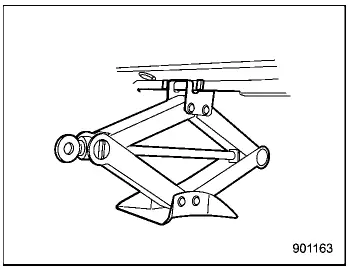
Rotate the jackscrew manually until the jack head is securely seated against the designated lifting point, ensuring proper alignment.
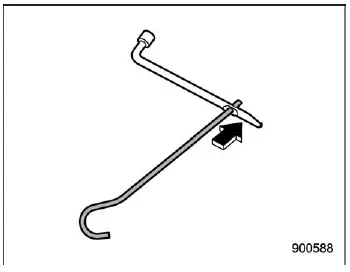
9. Insert the jack handle into the opening of the wheel nut wrench to create a leverage tool.
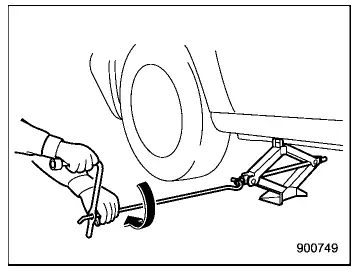
10. Fit the jack handle into the jackscrew and rotate it steadily until the flat tire is lifted off the ground. Raise the Subaru Ascent only as much as necessary to remove the wheel safely.
11. Fully remove the loosened wheel nuts and carefully take off the damaged tire.
For improved safety and efficiency, always perform tire replacement procedures in a well-lit area and consider using reflective warning equipment. Proper handling ensures that your Subaru Ascent remains reliable and safe even in unexpected roadside situations.
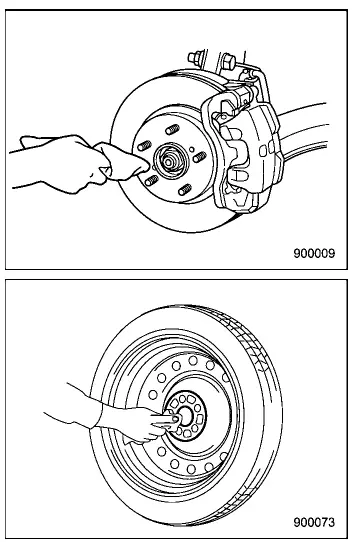
12. Before installing the spare tire on your Subaru Ascent, тщательно clean the contact surfaces of both the wheel and the hub using a clean cloth. Removing dirt, rust, or debris ensures proper seating of the wheel and helps maintain correct torque and alignment.
13. Carefully position the spare tire onto the hub of your Subaru Ascent. Reinstall the wheel nuts and tighten them by hand initially to ensure proper threading and alignment.
WARNING
Never apply oil or grease to the wheel studs or nuts when mounting the spare tire. Lubrication can reduce friction and cause the wheel nuts to loosen while driving, significantly increasing the risk of wheel detachment and a serious accident.
14. Gradually lower the vehicle by turning the jack handle counterclockwise until the Subaru Ascent is fully resting on the ground.
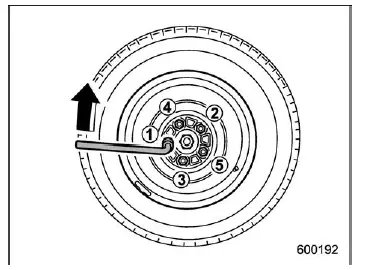
15. Using the wheel nut wrench, firmly tighten the wheel nuts to the specified torque value, following the proper tightening sequence illustrated in the diagram. This step is essential to ensure even pressure distribution and safe wheel installation on your Subaru Ascent.
For exact torque specifications, refer to the "Tires" section of your Subaru Ascent manual. Avoid using excessive force, such as stepping on the wrench or using pipe extensions, as this may result in over-tightening and potential damage. It is strongly recommended to have the torque verified at a professional service center.
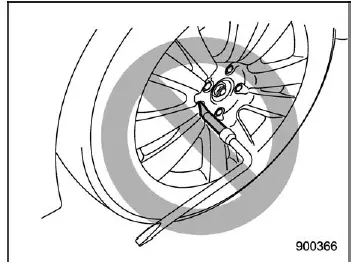
WARNING
Do not use any extensions when tightening wheel nuts. Doing so may prevent achieving the correct torque specification, causing the nuts to loosen over time and potentially leading to a dangerous situation while driving your Subaru Ascent.
16. Place the removed flat tire securely into the spare tire holder provided in your Subaru Ascent.
Refer to the section "Removing the spare tire" for proper storage location, procedures, and safety precautions.
17. Return the jack, jack handle, and wheel nut wrench to their designated storage compartments to prevent movement while driving.
WARNING
Never leave the removed tire or tools inside the passenger compartment. In the event of sudden braking or a collision, unsecured objects may become dangerous projectiles and cause injury. Always store all equipment properly in your Subaru Ascent.
Tire pressure monitoring system (TPMS) (U.S.-spec. models)
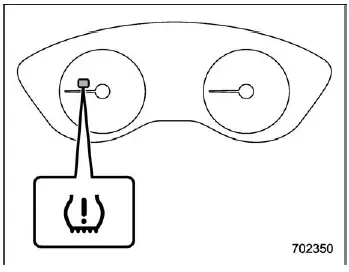
The Tire Pressure Monitoring System (TPMS) in your Subaru Ascent continuously monitors tire pressure by receiving signals from sensors installed in each wheel. When tire pressure drops significantly, the system alerts the driver with a warning message.
The TPMS becomes active only when the Subaru Ascent is in motion, meaning it may not provide immediate feedback when the vehicle is stationary.
Additionally, the system may not instantly detect rapid air loss, such as in the case of a sudden puncture or blowout caused by road hazards.
WARNING
- If the low tire pressure warning light illuminates while driving your
Subaru Ascent, do not brake abruptly. Instead, follow these safety steps carefully.
- Maintain a straight driving path while gradually reducing speed to retain control of the vehicle.
- Carefully steer your Subaru Ascent off the roadway to a safe location, away from traffic.
- Inspect all four tires and adjust their pressure to the recommended COLD tire pressure listed on the driver-side door pillar label.
If the warning light remains illuminated after correcting the tire pressure, one or more tires may be severely damaged and losing air rapidly.
In such cases, replace the affected tire with the spare tire as soon as possible to ensure safe operation of your Subaru Ascent.
- If a spare tire is installed or a wheel is replaced without transferring
the original pressure sensor, the TPMS warning light will blink for about one
minute and then remain steadily illuminated.
This indicates that the system cannot monitor all four wheels properly.
Contact your SUBARU dealer promptly for sensor installation, tire replacement, or system reset to restore full functionality.
- If a tire has been repaired using liquid sealant, the TPMS sensor and
valve may no longer function correctly. In such cases, consult a qualified service
center or SUBARU dealer as soon as possible.
When replacing the tire, ensure the TPMS sensor and valve are also replaced if necessary. The wheel itself may be reused provided it is undamaged and thoroughly cleaned of any sealant residue.
If the TPMS warning light continues to illuminate after blinking for approximately one minute, have the system inspected immediately to avoid further complications.
For enhanced safety and long-term reliability, regularly inspect your Subaru Ascent tires and maintain proper inflation levels, as correct tire maintenance directly impacts vehicle stability, braking performance, and fuel efficiency.
Related manual topics
Tire inspection
Perform a visual inspection of the tires on your Subaru Ascent on a daily basis
to ensure they are free from serious damage, embedded nails, stones, or other foreign
objects. At the same time, carefully examine the tread surface for any signs of
uneven or abnormal wear, which may indicate unde ...
Sonar Audible Alarm function
In the Subaru Ascent, the Reverse Automatic Braking (RAB) system is supported
by an advanced sonar audible alert function designed to enhance driver awareness.
When the system detects a potential obstacle while reversing, it emits warning sounds
in three distinct intensity levels, helping the ...