

The Subaru Ascent BSD/RCTA system includes multiple coordinated functions designed to improve driving safety.
- Detection of vehicles located in blind spots or rapidly approaching from adjacent lanes (Blind Spot Detection)
- Detection of vehicles approaching from either side when reversing (Rear Cross Traffic Alert)
These features rely on radar sensors strategically positioned on the Subaru Ascent to provide accurate environmental monitoring.
NOTE
The BSD/RCTA radar system in the Subaru Ascent complies with radio frequency regulations in the U.S., Canada, and other FCC-compliant regions. When operating the vehicle in other countries, ensure compliance with local certification requirements. Refer to "Certification for the BSD/RCTA" for more details.
Blind Spot Detection (BSD)
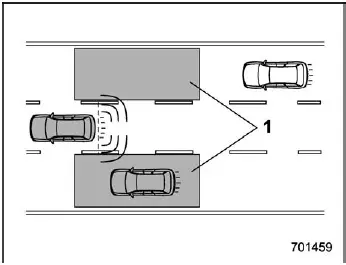
- Operating range
The Subaru Ascent BSD system provides warnings under the following conditions.
- When a vehicle is detected in the blind spot, the BSD/RCTA approach indicator lights on the corresponding side mirrors will illuminate.
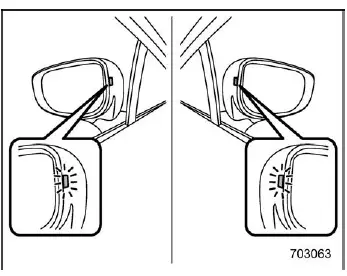
BSD/RCTA approach indicator li
- If the driver activates the turn signal toward the side where the indicator is illuminated, the BSD/RCTA indicator light will begin flashing, providing an additional warning.
Lane Change Assist (LCA)
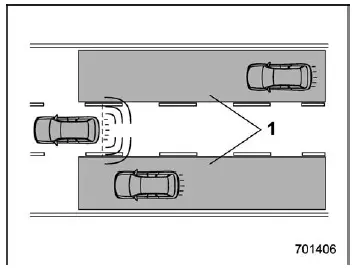
- Operating range
The Lane Change Assist function in the Subaru Ascent enhances safety during lane changes by detecting vehicles approaching at higher speeds in neighboring lanes.
- If a fast-approaching vehicle is detected, the BSD/RCTA indicator light on the side mirror will illuminate.
- If the driver signals a lane change in that direction, the indicator light will flash to warn of potential danger.
Rear Cross Traffic Alert (RCTA)
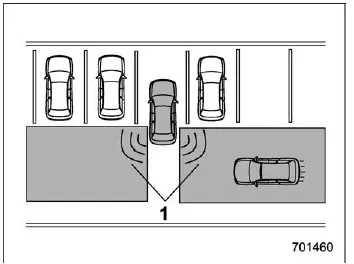
- Operating range
The Rear Cross Traffic Alert system in the Subaru Ascent is particularly useful when reversing from parking spaces, as it detects vehicles approaching from the sides.
When a vehicle is detected approaching from either side while reversing, the Subaru Ascent provides multiple alerts to ensure driver awareness.
- The BSD/RCTA indicator lights on the side mirrors will flash.
- An audible warning buzzer will sound.
- A visual warning icon will appear on the rearview camera display.
Limitations of the detectability of RCTA
Due to the physical limitations of radar detection, the RCTA system in the Subaru Ascent may not function optimally in certain situations, such as angled parking configurations.
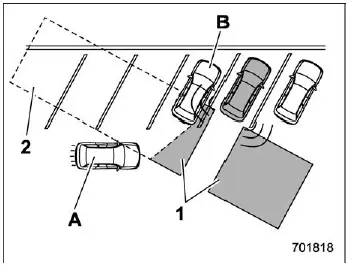
Example 1
- The detection range of the radar sensors
- Area out of detection range of the radar sensors
- Vehicle that may not be detected
- Parked vehicle
WARNING
A moving vehicle (A) may not be detected if its path is obstructed by another vehicle (B), limiting the radar’s coverage area. Always visually check surroundings when reversing the Subaru Ascent.
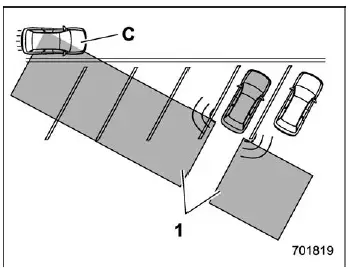
Example 2
- The detection range of the radar sensors
- Vehicle that may be detected
NOTE
The Subaru Ascent system may also detect vehicles passing in front of your path (C), depending on radar conditions.
Always confirm visually before reversing, as system detection may vary depending on surroundings and environmental conditions.
The Subaru Ascent BSD/RCTA system provides an additional layer of protection and awareness, but it works best when combined with attentive driving and proper mirror and shoulder checks.
Related manual topics
Uniform tire quality grading standards
The Uniform Tire Quality Grading (UTQG) system provides valuable comparative
information about tire performance, specifically in the areas of treadwear, traction,
and temperature resistance. For Subaru Ascent owners, understanding these ratings
can help in selecting the most suitable tires for ...
Spark plugs
Replacing spark plugs in your Subaru Ascent can be technically challenging due
to limited access and engine layout. For this reason, it is recommended to have
this service performed by a qualified SUBARU dealer.
Spark plugs should be replaced at the intervals specified in the "Warranty and ...