

The Subaru Ascent is equipped with an advanced SRS frontal airbag system engineered to provide effective protection during specific types of collisions. The driver's and front passenger's SRS frontal airbags are carefully calibrated to deploy only under conditions where additional protection beyond seatbelts is necessary.
The Subaru Ascent frontal airbag system is designed with the following operational characteristics:
- To deploy primarily in moderate to severe frontal collisions where significant impact forces are detected
- To function as a one-time activation system that deploys only once per collision event
However, the Subaru Ascent SRS frontal airbags are not intended to operate under the following conditions:
- They typically do not deploy in minor or low-speed frontal impacts*1
- They are not designed to deploy in most side impacts, rear collisions, or rollover situations*2
*1: In such cases, the seatbelt system alone usually provides sufficient protection.
*2: Frontal airbag deployment would not effectively protect occupants in these types
of impacts.
The deployment of the Subaru Ascent airbags depends on the actual force transmitted to the passenger compartment during a crash. It is important to note that visible damage to the vehicle may not accurately reflect the level of force experienced by occupants.
Example of accident in which the driver's/driver's and front passenger's SRS frontal airbag(s) will most likely deploy
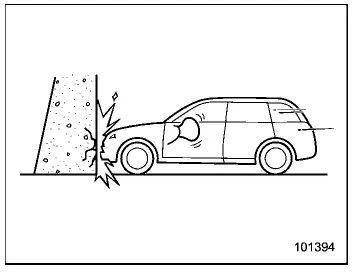
In the Subaru Ascent, a direct head-on collision with a rigid object such as a concrete barrier at speeds of approximately 12 to 19 mph (20 to 30 km/h) or higher will typically result in deployment of the driver’s airbag or both driver and front passenger airbags. Similar frontal impacts with equivalent force characteristics may also trigger deployment.
Examples of the types of accidents in which it is possible that the driver's/driver's and front passenger's SRS frontal airbag(s) will deploy
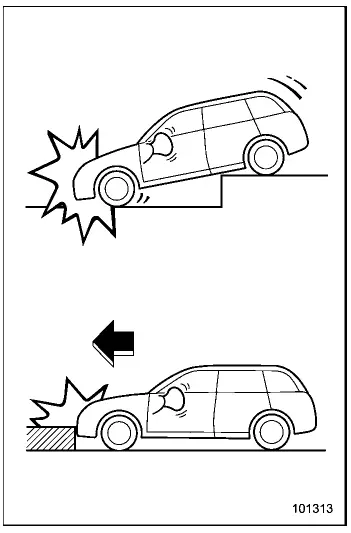
In certain Subaru Ascent scenarios, airbags may deploy even without a classic frontal collision. For example, a strong impact to the underside of the vehicle—such as dropping into a deep pothole, hitting a curb, or striking a road obstacle—can generate sufficient force to activate the system.
Examples of the types of accidents in which deployment of the driver's/driver's and front passenger's SRS frontal airbag(s) is unlikely to occur
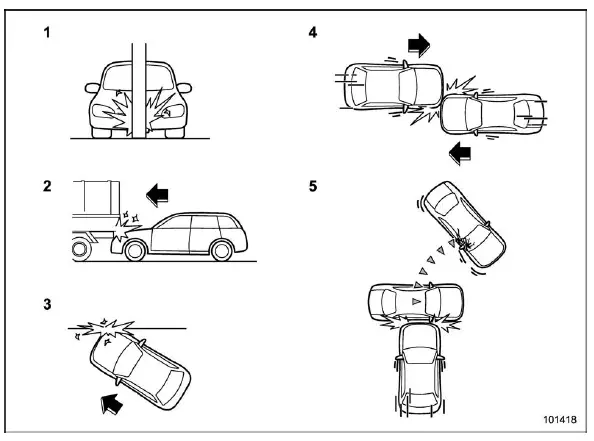
- The Subaru Ascent strikes a narrow object such as a pole or signpost.
- The vehicle slides underneath a truck or similar structure.
- The vehicle experiences an angled or offset frontal impact.
- The vehicle is involved in a partial overlap collision.
- The vehicle hits an object capable of moving or deforming, such as another parked vehicle.
In these types of collisions, the Subaru Ascent SRS frontal airbags may or may not deploy depending on the magnitude and direction of the impact forces transmitted to the cabin.
Examples of the types of accidents in which the driver's/driver's and front passenger's SRS frontal airbag(s) are not designed to deploy in most cases
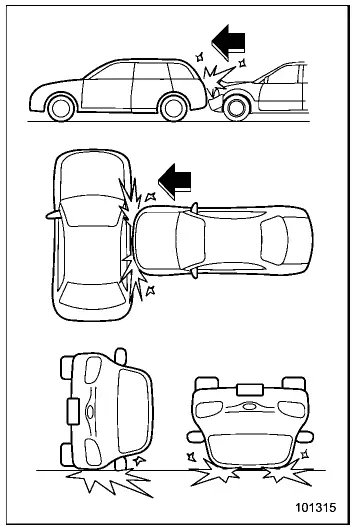
The Subaru Ascent frontal airbags are generally not designed to deploy in the following situations:
- Side impacts or collisions from the rear
- Rollover events where the vehicle tips or overturns
- Low-speed frontal impacts that do not generate sufficient force
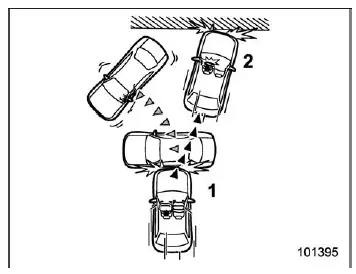
- First impact
- Second impact
In the Subaru Ascent, SRS airbags are designed for single deployment only. In multi-impact accidents, such as when the vehicle first collides with another car and then hits a fixed object like a wall, the airbags will deploy only during the initial impact event.
For example, if the Subaru Ascent experiences a double collision, the system will activate the airbags during the first significant impact. Once deployed, the airbags will not activate again during subsequent impacts within the same event.
Understanding how and when the Subaru Ascent SRS airbag system activates helps drivers and passengers better appreciate its role in vehicle safety and reinforces the importance of proper seatbelt use in all driving conditions.
Related manual topics
Loading your vehicle
WARNING
Never allow passengers to sit or ride in the cargo area of the Subaru
Ascent, especially on folded rear seatbacks. This practice is extremely dangerous
and can result in serious injury in the event of sudden braking or a collision.
Do not stack luggage or cargo higher than the to ...
Driver Monitoring System
The Driver Monitoring System, known in some markets as DriverFocus, is an advanced
safety and personalization feature integrated into the Subaru Ascent. This intelligent
system continuously observes the driver’s behavior to detect signs of distraction
or reduced attention, while also identifyi ...